
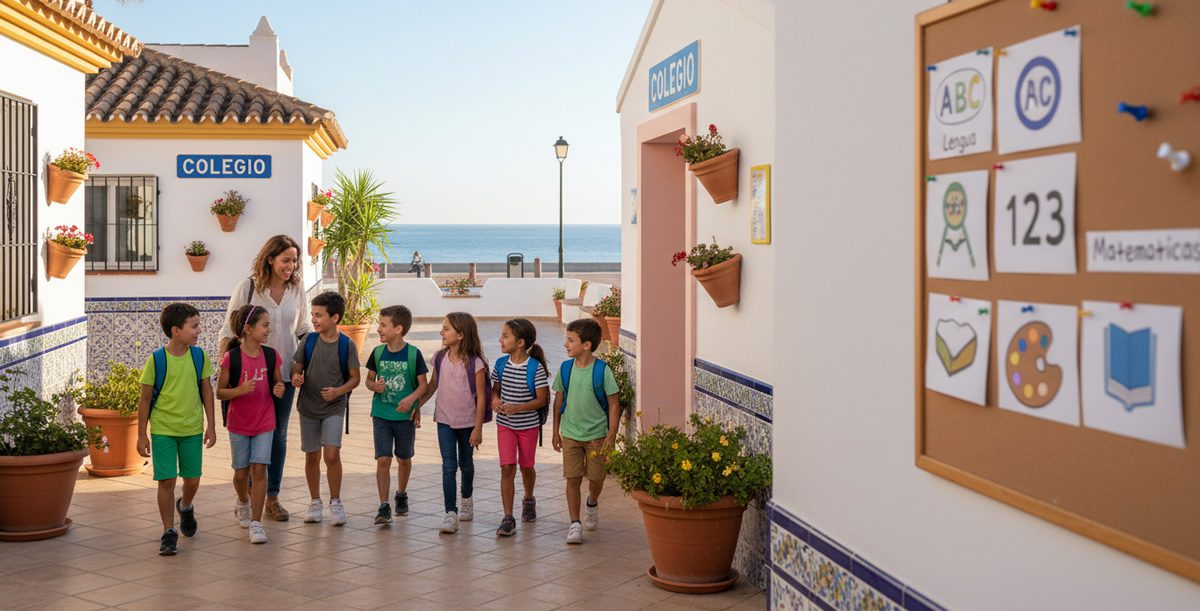
Whether you’re relocating to Torre del Mar temporarily or planning a long-term stay, understanding Spain’s education system is key to settling in successfully. The Costa del Sol offers a wide range of schooling options for international and local families, from free state schools to private international institutions, as well as diverse family-friendly amenities and community networks.
Overview of the Spanish Education System
Spain’s education system is overseen nationally by the Ministry of Education, but each region has some autonomy, particularly regarding language and curriculum. In Andalucía, teaching is primarily in Spanish, with optional bilingual programmes in English or French.
Education Stages in Spain
| Stage | Age Range | Description |
| Infantil (Early Years) | 0–6 | Non-compulsory but popular. Often divided into 0–3 (nursery) and 3–6 (preschool). |
| Primaria (Primary) | 6–12 | Compulsory education covering core subjects like maths, Spanish, social studies, and English. |
| ESO (Secondary) | 12–16 | Compulsory secondary education leading to a school-leaving certificate. |
| Post-Compulsory Options | 16+ | Either Bachillerato (university-preparation track) or Formación Profesional (vocational training). |
Types of Schools Available
There is a variety of schools available form state-funded to international schools which may follow a foreign curriculum.
This is a breakdown of the main options available.
1. State Schools (Públicos)
- Fully funded by the government and free to attend.
- Teaching is mainly in Spanish, though some offer bilingual programmes.
- Open to all residents with official registration (empadronamiento).
- Admission is based on catchment area and availability.
2. Semi-Private Schools (Concertados)
- Run by private organisations (often Catholic) but partially funded by the state.
- Families pay modest monthly fees, typically under €200.
- These schools often combine strong academics with additional activities.
- Many offer partial bilingual instruction.
3. Private and International Schools
- Fully fee-paying institutions following either the Spanish or a foreign curriculum.
- Options on the Costa del Sol include British, American, French, and International Baccalaureate (IB) systems.
- Ideal for families who move frequently or plan university study abroad.
- Fees range between €4,000 and €20,000+ per year.
Private & International Schools near Torre del Mar
- Novaschool Añoreta – Añoreta, Spanish curriculum, all ages.
- Genius International Montessori – Spanish curriculum – Montessori method
- Lycée Français de Málaga – French and international curriculum – elementary to 18 years
Bilingual and International Education Options
Many public and concertado schools in Andalucía now offer bilingual programmes, often teaching subjects such as Science or Art in English using the CLIL method (Content and Language Integrated Learning).
International families can also choose fully international schools that follow foreign curricula and award globally recognised qualifications, such as:
- British Schools: IGCSEs and A Levels
- American Schools: High School Diploma and SAT/AP exams
- French Lycées and German Schools
- International Baccalaureate (IB) programmes
Post-16 Education and University Pathways
The Spanish education system means students have to choose a study area. This means subjects are pre-determined and students cannot mix sciences with humanities, for example.
Bachillerato (Ages 16–18)
- Two-year academic programme preparing students for university entry.
- Ends with the EBAU (Evaluación del Bachillerato para el Acceso a la Universidad) exam, Spain’s national university entrance test.
- Subjects depend on the student’s chosen study area (sciences, arts, humanities, etc.).
University Access
- Spanish universities require EBAU results for entry.
- International students with A Levels, IB, or equivalent can apply through UNEDassis, the national access system for foreign qualifications.
- Some private universities offer alternative admission routes, such as interviews or internal assessments.
Formación Profesional (FP) – Vocational Education
Spain’s FP system is a respected and practical route for students seeking technical or career-based training.
| Level | Entry Requirement | Outcome |
| Grado Medio | After ESO (age 16) | Technician or skilled trade qualifications. |
| Grado Superior | After Bachillerato or Grado Medio | Advanced qualifications that can also lead to university study. |
Courses combine classroom learning with real work placements and are available in sectors like:
- Tourism and hospitality
- Health and social care
- IT and engineering
- Renewable energy
- Design and audiovisual production
Early Childhood Education and Nurseries
For younger children, Torre del Mar and the Axarquía region offer numerous guarderías (nurseries) and escuelas infantiles (preschools).
- Public nurseries are subsidised and may have waiting lists.
- Private nurseries operate independently and often include English-language options.
- Many follow Montessori or Reggio Emilia-inspired methods.
Support for International Families
Families moving to Spain can expect practical support through:
- Local education departments (Delegación de Educación) for registration and school placement.
- Language immersion programmes for non-Spanish-speaking students.
- Parent associations (AMPAs) that help families integrate into the local school community.
Bilingual coordinators or English-speaking teachers are increasingly available in many schools across the Costa del Sol.
Family Life in Southern Spain
Living on the Costa del Sol offers a relaxed, family-friendly environment where community and outdoor life are central.
Lifestyle and Daily Rhythm
- The day typically follows a later schedule, with lunch around 2–3 p.m. and dinner after 9 p.m.
- Children are often included in social life, with families dining out together well into the evening.
- Afternoon siestas are less common in coastal towns but schools still run split schedules, often finishing between 2 and 3 p.m.
Family Support and Community
- Extended families play a major role in childcare and social life.
- Many neighbourhoods have local playgrounds (parques infantiles), sports clubs, and extracurricular activities (actividades extraescolares) like music, dance, and football.
- Health services for families are well developed, with public healthcare free for residents and private options widely available.
Cost of Living and Amenities
- Torre del Mar offers a balance between affordability and modern infrastructure, including healthcare, shopping centres, and sports facilities.
- Public transport links to Málaga and nearby towns make commuting and weekend trips easy.
Useful Resources
| Resource | Description | Website/Contact |
| Ayuntamiento de Vélez-Málaga | Town Hall for school enrolment and local services | https://www.velezmalaga.es/ |
| Junta de Andalucía – Educación | Regional education portal with school listings and admissions info | https://www.juntadeandalucia.es/educacion/ |
| UNEDassis | University access for international students | https://unedasiss.uned.es/home |
Key Considerations for Families Moving to Torre del Mar
- Free public schooling is available for all residents and provides full immersion in Spanish language and culture.
- Concertado schools offer an affordable middle ground with smaller class sizes and optional bilingual teaching.
- Private international schools cater to multilingual families and those planning to return abroad or apply to foreign universities.
- FP and Bachillerato provide clear post-16 options leading to either higher education or professional careers.
- Family life on the Costa del Sol is social, safe, and community-oriented, with excellent outdoor facilities and a strong emphasis on quality of life.